
After withdrawing record funds in 2021-22, foreign portfolio investors (FPIs) continued their sell-off in the last fiscal too and pulled out Rs 37,631 crore from Indian equities amid aggressive rate hikes by central banks globally. The outflow trend is likely to reverse in the current financial year since India has the best growth potential in the financial year 2023-24 (FY24), VK Vijayakumar, chief investment strategist at Geojit Financial Services, said. Market analysts believe that FPI flows in the current financial year would be decided by a host of factors, such as the US Federal Reserve's policy stance, oil prices movement and development in the geopolitical situation.

On a five-day rolling basis, FPI selling is the highest in 24 years.

'Returns can be very variable in equity markets.' 'That is why I tell small investors don't put 100 per cent of your money in equities, even if you are young.'

'It is advisable to invest in them early in life and stay invested for a longer period to achieve long-term goals and accumulate wealth.'

'Those satisfied with returns and not expecting further rally could be booking profits and also stopping SIPs.'

'We remain positive on technology, private sector financials, gas, infrastructure, and export-oriented plays.'

Inflows into sector and thematic (S&T) funds fell sharply from around 5,711.6 crore in February 2025 to about 170.1 crore in March 2025 - a decline of 97 per cent. With many such funds underperforming, investors need to assess whether to remain invested or exit.

'The potential headwind is that the Indian economy is likely to see a slowdown in growth rates over the next two years.'

NSE also said it will not charge any transaction fees on trade in interest rate futures for one more year.

'You can put 25 per cent right now; put another 25 per cent when Nifty corrects another 500 points.' 'At 13,500 put another 25 per cent and at 13,000 one can get fully deployed.'

'We like certain stocks from banking, insurance, retail, hospitals and capital goods.' 'Though some of these stocks may seem expensive, they will compound well over the long term, thus justifying their current multiples.'

'We emphasise the importance of not basing investment decisions solely on electoral outcomes.' 'Instead, focusing on investing in high-quality businesses capable of prospering regardless of the political landscape is paramount.'

Earnings growth, attractive valuations and change in FPI flows from negative to positive over the next 12 months are some of the key triggers for an upside. "A poor monsoon, high inflation and further rate hike are some of the key risks

Among the Sensex firms, NTPC, Mahindra & Mahindra, Wipro, Kotak Mahindra Bank, Tata Steel, Asian Paints, Bharti Airtel, Power Grid, Titan and HDFC Bank were the major gainers. Bajaj Finance, Bajaj Finserv, Infosys, Tata Consultancy Services, Tata Motors and HCL Technologies were the laggards.

Fundraising momentum is expected to accelerate further in the New Year, potentially surpassing 2024's record figures

India's mergers & acquisitions (M&As) market recorded deals worth $45.44 billion in the first half of 2025, up nearly 3.3 per cent from a year ago, even as ultra large-ticket transactions remained subdued. During the first half, the 7.1 per cent rise in deal count to 1,614 signals continuing appetite among domestic conglomerates and private equity (PE) funds for mid-sized and smaller assets.

Without changes to the taxation rules, buybacks are expected to remain scarce.

'I am more optimistic about India than before.'

From the 30 Sensex companies, IndusInd Bank, Zomato, Larsen & Toubro, Titan, Mahindra & Mahindra, Bajaj Finance, Reliance Industries, Kotak Mahindra Bank, Tech Mahindra and Tata Consultancy Services were among the laggards. On the other hand, Power Grid, Hindustan Unilever, Infosys, Nestle India, Asian Paints, ITC, Sun Pharmaceuticals and ICICI Bank were the gainers.

While demand for sub Rs 50-lakh affordable housing prevails, market players cite increased land rates, escalated construction costs and low margins as key prohibiting factors.

rediffGURU Ramalingam Kalirajan answers your personal finance queries.
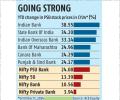
Stock Market News today, PSU banks: The year 2024 was a roller-coaster ride for Indian stock markets, marked by volatility driven by the Lok Sabha elections, Union Budget 2024, a slowdown in corporate earnings, and sticky inflation. Geopolitical tensions - particularly between Israel and Iran in West Asia - along with various stimulus announcements by China and yen carry trade rocked the equity markets throughout the year.

U K Sinha said the equity market also helps in the growth of the Indian economy as the money invested in equities is utilised for infrastructure-building

The net inflows into active equity mutual fund (MF) schemes registered more than a twofold month-on-month rise in August, crossing Rs 20,000 crore, the highest in five months. This rise in net inflows was boosted by an 18 per cent growth in gross investments, driven by a record Rs 15,800 crore inflow through the systematic investment plan (SIP) route and Rs 5,000 crore collected by seven new fund offers (NFOs) in the active equity space, reveals data released by the Association of Mutual Funds in India (Amfi). Moreover, redemptions moderated in August, declining by 19 per cent to Rs 24,580 crore, after staying elevated in the previous three months owing to profit booking.

Inflow in equity mutual funds halved to Rs 3,240 crore in May, declining for the second consecutive month, primarily due to profit booking by investors amid rising market. However, this was also the 27th consecutive month of inflow in the equity class, which was primarily driven by fund infusion in small-cap and mid-cap categories, data released by the Association of Mutual Funds in India (Amfi) showed on Friday. Overall, the 42-player mutual fund industry continues to see inflow and attracted Rs 57,420 crore, on contributions from debt-oriented schemes.

'India represents one of the top opportunities with robust growth, solid fundamentals, and openness to foreign investment.'

ELSS investments require a long-term commitment of at least seven years.

'Just because you don't see them does not mean they don't exist.' 'The greatest risk is overconfidence.

'India's march towards being a $5 trillion economy continues, notwithstanding momentary setbacks.' 'India is at an inflexion point and most economists believe this growth super-cycle will extend for over four decades.'

After a year of decline, mergers and acquisitions (M&As) in India increased 13.8 per cent, reaching $69.2 billion in the first nine months of 2024, as against $60.8 billion during the same period in 2023. Led by Indian companies and private-equity (PE) firms, 2,301 transactions were signed between January and September this year as compared to 1,855 transactions reported in the same period last year, according to the Bloomberg data.

Will 2022 be a year of contrasting narratives -- one filled with caution and the other with continued optimism?

Sentiments may get impacted as mutual funds have been gaining traction among investors as route to invest in stock markets

Debt-oriented mutual funds witnessed an outflow of Rs 6,525 crore in February, a sharp reversal from the strong inflow of Rs 1.28 lakh crore in the preceding month, chiefly due to redemptions in short-duration funds. Notably, 10 of 16 debt mutual fund categories reported net outflow during the month, data with Association of Mutual Funds in India (Amfi) showed.

Reliance Jio, India's biggest telecom operator, is planning to launch an initial public offering (IPO) and listing on bourses in the first half of 2026, billionaire Mukesh Ambani said on Friday. Jio is currently a unit of Reliance Industries Ltd, India's most valuable company.

'The market should maintain optimism on the back of range-bound oil prices, a robust fiscal balance sheet, a better-than-expected monsoon, and moderating inflation.'

The spike in volatility, amid election uncertainty, has done little to dent the confidence of retail investors, shows demat account addition and equity mutual fund (MF) investment data. In May, investors opened a net 3.6 million demat accounts, taking the total to 158 million. MF data released on Monday pegged the net inflows into equity schemes and SIP investments at new record highs of Rs 34,697 crore and Rs 20,904 crore, respectively.

'While investors believe in India's long-term growth story and resilience amid global uncertainty, they see near-term risks around the direction of a global trade war.'

The net inflow in equity mutual funds plunged 76 per cent to Rs 2,258 crore in November over the preceding month amid a sharp up move in the stock market that made investors wary of higher valuation. This also marks the 21st straight month of inflows into equity schemes. Overall, the mutual fund industry registered net inflows of Rs 13,263 crore in November, slightly lower from Rs 14,045 crore seen in the previous month, data released by the Association of Mutual Funds in India (Amfi) showed on Friday.

The changes will take effect on March 28, with portfolio adjustments expected before the market closes on March 27.
'In the overall global portfolio, India's weighting has come down in the past seven months.'
